Are We Really Doing This?
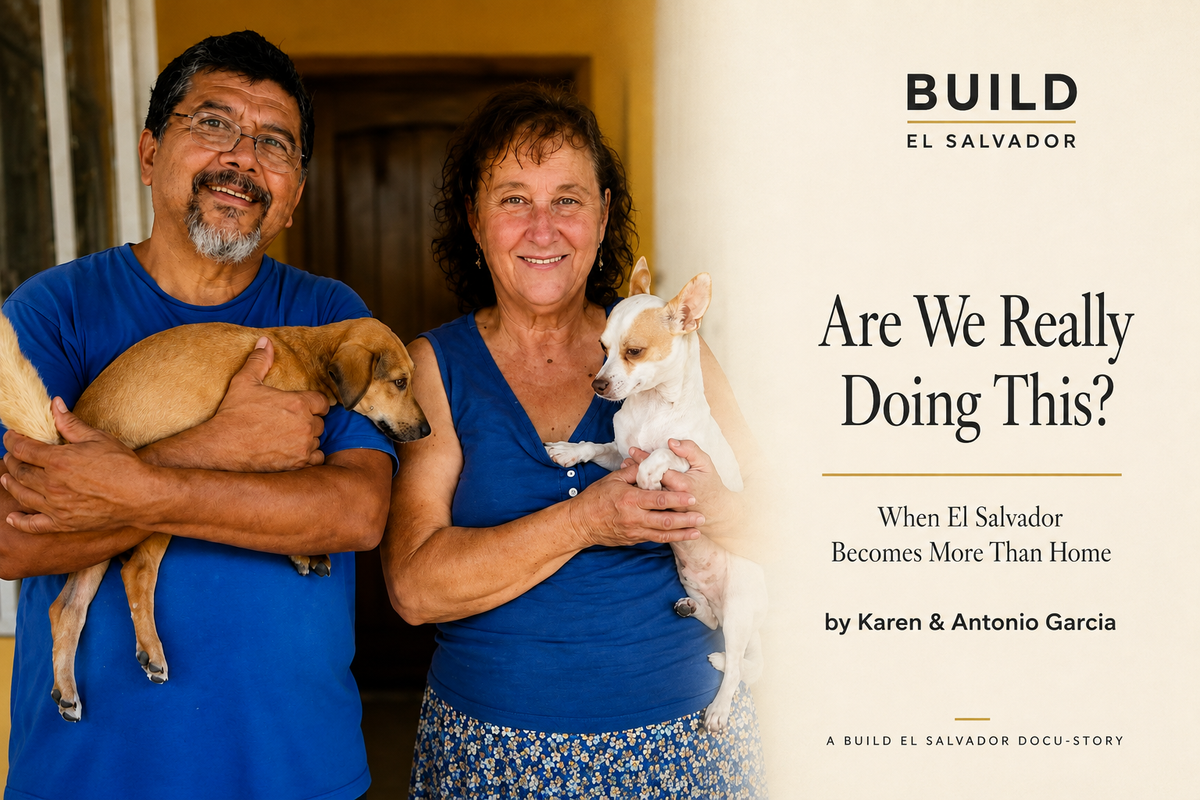
When El Salvador Becomes More Than Home
By Karen & Antonio Garcia · Documented by Judith Price
Karen Garcia is convinced that she and Antonio have a sign. Not the kind you hang on a gate or stick in a window; this one is invisible, at least to people. Dogs, apparently, read it just fine: WE’RE OVER HERE. WE’LL TAKE YOU HOME.
She’s joking... Sort of. Because dogs have an uncanny habit of turning up wherever Karen and Antonio happen to be. Beside roads, behind trucks, near beaches, in places any sensible person would just keep driving past. And Karen and Antonio are sensible people. They know they already have enough animals. They know they CAN’T take another one. They’ve said so, many times. Then they stop the truck.
Somewhere along the way, that’s what Karen and Antonio became: ‘the people who stop.’
“And Antonio is the practical one,”
Karen says, with a wry smile, a claim that would land better if he weren’t usually the one who spots the dogs first. His explanation is that he’s driving, so naturally he sees the road before she does. Karen isn’t buying it. Neither, frankly, am I. Whatever these dogs can see hovering over the two of them, the message is getting through, and their ability to ignore it is close to nonexistent.
The sign, it turns out, was already up before they’d finished unpacking. Karen and Antonio had only been in El Salvador two weeks, still living out of a hotel while their house was remodeled, when they passed two puppies on the side of the road. They stopped, took them to the vet, and brought them home. There was no plan to foster, no search for someone else to take them. They just kept them: Betsy and Bella.
Rescue has a way of reminding you quickly that stopping doesn’t guarantee a happy ending. Bella caught distemper and didn’t survive it. Sometimes you do everything right and still lose one. Betsy made it. And the sign kept working.
Then came Ruby. Driving through San Luis Talpa, they spotted a small dog frantically chasing one of the pickup trucks that run as informal taxis here. When the truck pulled away, the dog ran after it, nearly a kilometer, in the heat. Karen and Antonio followed until the truck finally stopped. Antonio caught the dog. Nobody in the taxi would claim her, though a collar and neatly trimmed nails suggested someone, somewhere, had cared for this dog recently. The vet didn’t recognize her either. So she came home with them, ‘temporarily’, they told themselves, which by now should have been their first clue. Ruby got sick. She needed surgery. They paid for it. Ruby stayed.
Three rescue cats joined the household somewhere in the middle of all this. The sign, apparently, isn’t species-specific.
By this point Karen and Antonio had settled on what sounded like a sensible household policy: “we can’t keep doing this.” Nobody was enforcing it. Least of all the practical one.
The animals kept appearing, they kept stopping, and “we can’t keep doing this” was turning into less of a rule and more of a family motto nobody actually intended to follow.
Then came Charlotte and Delilah. Driving to get Antonio’s blood work done, they passed two tiny puppies sitting on the shoulder of the highway. There was no way to turn around immediately, the road doesn’t allow it out there. So they had to keep driving until they found a place to circle back, not knowing whether the puppies would still be there when they did.
They were: nine or ten weeks old, sitting almost exactly where they’d first been spotted, with food someone had left beside them. When Karen and Antonio approached, the puppies didn’t run. Their tails wagged. To Karen, that told her something. In her experience, puppies born on the street tend to be wary of people, but these two weren’t. Someone had fed them, handled them, taught them humans were safe. And then, Karen believes, that same someone left them on a highway anyway.
So they stopped. Of course they did. But this time the familiar routine ran into a real problem. There were already dogs at home, cats, vet bills, food, medication, and a no-more-animals policy with a track record of failure. This time, “we can’t keep doing this” wasn’t a joke. They genuinely couldn’t. Not because they cared any less about Charlotte and Delilah, but because caring about an animal and being able to give it a permanent home turned out to be two very different things.
For the first time, the sign needed an amendment. WE’LL TAKE YOU HOME couldn’t be the answer every time. Maybe it didn’t have to be. Maybe sometimes it could just say WE’LL HELP YOU GET HOME. Karen and Antonio just had to find out who could help them keep that promise.
That’s when she called Tito's Hope Rescue.
By the time she reached Sherry Lotterer, Tito's Hope CEO, there wasn’t much rescuing left to do. Karen and Antonio had already taken the puppies to the vet, arranged the bloodwork and deworming, and paid for it themselves. Sherry wanted to know why they’d done all of that before even calling. To Karen, the answer was simple: they were the ones who’d stopped, they were the ones who’d picked the puppies up, which made Charlotte and Delilah their responsibility, full stop.
The call lasted nearly an hour, and somewhere in it, what started as a conversation about two puppies turned into something bigger. Karen and Antonio discovered they weren’t the only ones carrying invisible signs. There was Sherry. There was Dr. Gabby, doing the hands-on fieldwork. Dr. Diana, providing veterinary care. People who fostered. People who trained dogs to make them more adoptable. People searching for permanent homes. Different people, carrying different signs, doing different pieces of the same job.
I CAN FOSTER. I CAN TREAT YOU. I CAN TRAIN YOU. I CAN HELP FIND YOU A HOME.
By the end of that first call, Sherry had invited them to join Tito's Hope foster and adoption team outright. They said yes.
Later, Sherry told them something else.
“If there were ten more of you,”
she said,
“we would really be able to turn around the stray dog and cat problem in El Salvador.”
Karen handed the compliment straight back.
“Imagine if there were ten more Dr. Gabbys and Sherrys,”
she told her.
“We would solve the problem.”
Two women, each trying to give the other the credit, neither one succeeding.
Sherry sees Karen and Antonio's contribution a little differently. What struck her from the beginning wasn't simply their willingness to foster, but how quickly they stepped in caring for animals, covering expenses, volunteering their time and taking responsibility before anyone had asked them to.
“She is not just a super supporter,”
Sherry says of Karen.
“SHE’S A MEGA SUPPORTER.”
Maybe they were both looking at it slightly wrong. El Salvador doesn’t need ten more Karens, or ten more Antonios, or ten more Sherrys or Gabbys. It probably needs a lot more ordinary people carrying invisible signs of their own. Not everyone’s sign can say I’LL TAKE YOU HOME. But almost everyone has something theirs can say.
Karen doesn’t think the answer is for everyone to become her and Antonio. In fact, the first thing she tells people who want to help is to understand the responsibility they’re taking on.
“There’s a lot of people who just want to do so much but can’t,”
Karen says.
Her advice is practical: get in touch with a rescue organization you can trust. Volunteer your time if that’s what you have. Donate if you can, because, as Karen puts it, “it comes down to money.”
And then there’s the simplest thing.
“Drive around with dog food in your car and feed them.”
Take a picture. Note the location. Send both to Tito's Hope. Someone may be able to go back and find the dog.
You don’t have to solve what happens next before you’re allowed to help with what is happening now. Sometimes the part that’s possible for you is simply making sure a hungry dog eats today.
Maybe you share an adoption post with the one person who turns out to be the right one. Maybe you give a little toward food or medical care. Maybe you leave a bowl of water outside, or buy an extra bag of food. You won’t have solved the stray-animal problem. You won’t have promised that dog a home. You’ll have done the part that was actually possible for you, which, Karen would tell you, is not nothing. Maybe that’s all an invisible sign needs to say: not I’LL TAKE YOU HOME, not I’LL FIX EVERYTHING, just I CAN HELP WITH THIS PART. Sometimes that’s enough.
Karen isn’t suggesting anything she and Antonio don’t already do. In fact, Antonio has taken the dog-food-in-the-car advice rather literally.
His invisible sign has four wheels.
There’s dog food in the truck now, permanently. Not because they’re headed to an adoption event, but because Antonio has learned there’s usually a hungry dog somewhere along the way. A couple of them live in the village near their house. He didn’t rescue them or adopt them. He just fed them. Then he fed them again. And again, until they figured him out.
Now, when Karen and Antonio drive through the village toward the highway, the dogs hear the truck before they see it, and they come running tails going, jumping up at Antonio’s door before he’s even fully out.
They don’t need Karen’s sign. They know his: not I’LL TAKE YOU HOME, just I CAN FEED YOU TODAY. Tomorrow they’ll still be village dogs. Antonio hasn’t solved that, and he knows it. But today they’re hungry, and today he has food. It’s a small promise. To a dog waiting beside the road, it doesn’t feel small at all.
For all the jokes about invisible signs and their track record of broken policies, Karen and Antonio know there’s a real limit, and it isn’t abstract. Karen is 67. Antonio is 64. These days, taking in another animal comes with a question neither of them can wave away: ‘what happens if this one outlives us?’
Karen doesn’t say it lightly. Loving an animal means thinking about what happens to it years down the road, not just what happens beside it today. So when they say 'we can’t keep doing this,' the joke and the truth are the same sentence. They can’t take every dog home. They can’t cover every vet bill. Nobody can. But there’s a big distance between ‘I can’t save them all’ and ‘I won’t help this one.’ And so far, Karen and Antonio haven’t learned how to make that leap. Maybe they never will.
Which is more or less how they ended up, not long after, at the beach with a puppy following them to the truck.
Heavy rain had flooded the low ground nearby, and the mosquitoes had multiplied into the kind of swarm that makes standing still feel like a mistake. Karen and Antonio were being eaten alive and ready to leave when a puppy appeared. Small, alone, and unbothered by them in a way that told Karen everything before she’d even reached down to touch the puppy. Somewhere along the way, this one had learned that people were safe. And the puppy apparently decided these two particular people would do.
They started walking back to the truck. It followed. They kept walking. It kept following, all the way to the truck door. By now they both knew the drill, and they both knew what was waiting at home. The dogs, the cats, the fosters, the vet bills, a no-more-animals policy that had failed often enough to barely count as a suggestion. Karen looked at Antonio. Antonio looked at Karen.
So much for the practical one.
They picked up the puppy and put her in the truck. Two people who had just finished explaining to themselves that they absolutely could not take another dog, doing exactly that.
“What the heck did we just do?”
Karen remembers thinking.
This time, though, something was different. The puppy never made it to their house. Before the night was over, they ran into Christian, the partner of a vet tech they knew who had recently lost his own dog. Karen and Antonio had a puppy they couldn’t keep. Christian had room for one. That night, the little dog from the beach went home with him instead.
There was no long fostering story, no complicated rescue, just one person who stopped, and another who could take it from there.
Karen and Antonio had seen her. They stopped. They got her into the truck.
Christian could do the part they couldn’t.
He could take her home.
Maybe Karen has had the wording on that invisible sign wrong all along.
It doesn’t always have to say:
WE’LL TAKE YOU HOME.
Sometimes Karen and Antonio’s only needs to say:
WE’LL STOP.
Someone else’s might say:
I HAVE FOOD.
I CAN FOSTER.
I CAN HELP.
And every once in a while, like that night at the beach:
I’LL TAKE YOU HOME.
One dog. Two people who stopped. Another person who had room.
Maybe that’s what it takes.
Not one person trying to save them all.
Maybe that's how things change.
One small sign at a time.
Tito’s Hope builds local community-based care networks, led by a mobile veterinarian team to give stray dogs and cats in El Salvador a fresh start.. supporting them on a complete path from rescue and healing to loving adoption.