The Day People Started Building Again
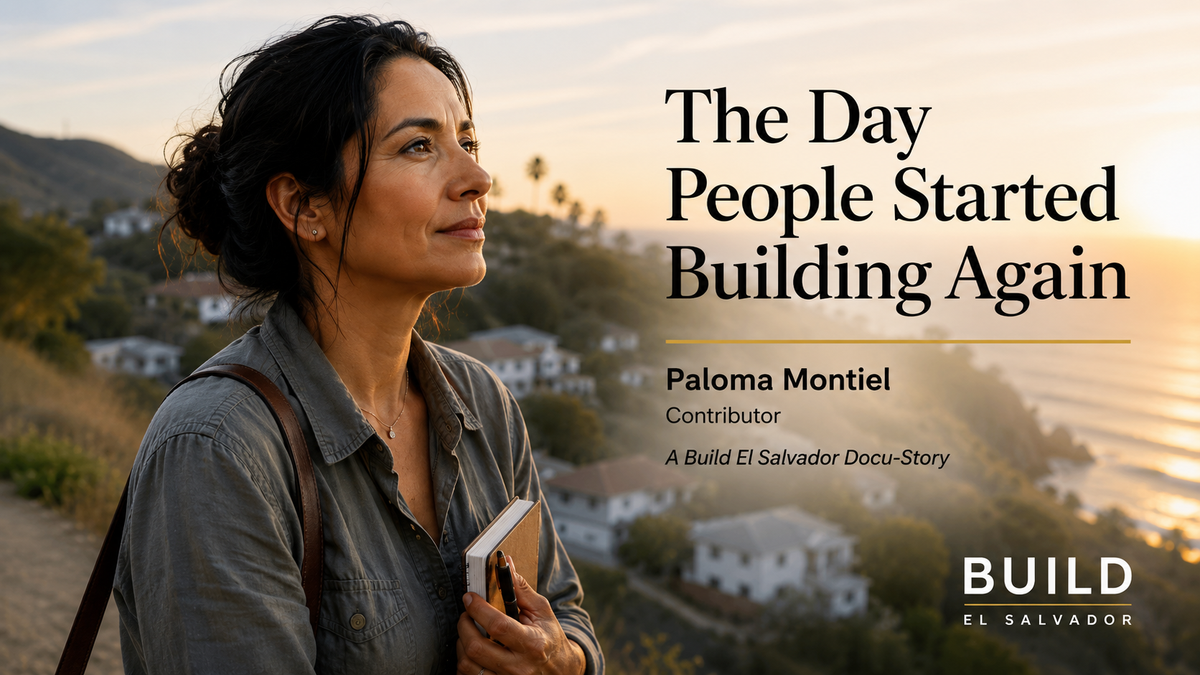
By Paloma Montiel · Contributor
The first time I drove that road, I barely noticed the houses.
I noticed the view. You couldn't not notice the view; the hillside dropped away toward the Pacific, and the water caught the light in a way that made it hard to keep my eyes on the road. It seemed like the kind of view people pay a great deal of money for, somewhere else.
Then I saw the woman.
She was walking up from the road toward one of the houses, a five-gallon jug of water balanced on her head, steady, unhurried, like she'd done it ten thousand times before. Because she had. There was no running water where she was going. No electricity either, as far as I could tell. Dinner would be cooked over a fire built from wood someone had gathered by hand.
She was walking home. To that view.
I couldn't stop thinking about the two of those things sitting next to each other. The house didn't match the water. The poverty didn't match the ocean. It was the kind of contradiction that doesn't resolve itself just because you keep staring at it, so eventually I stopped staring and kept driving.
I didn't go back right away. Months passed. When I did return, I expected to find the same road.
I didn't, entirely.
The water was still carried by hand. The firewood was still stacked beside the house, same as before. Whatever poverty I'd seen the first time hadn't left. But something had been added to it, and once I noticed the first one, I couldn't stop noticing the rest.
A concrete walkway where there used to be a worn dirt path. A retaining wall holding back a hillside that used to just erode. Window screens on a shack that still had rust creeping up its metal siding. Fresh paint on a wall two feet from an outdoor wood-fired kitchen that hadn't changed at all.
None of it was expensive. None of it was much, really, if you priced it out. A few bags of concrete. A roll of screen mesh. A can of paint.
But somebody had decided this place had a future worth building.
That's not a small thing to decide, if you've spent years believing otherwise.
So I started asking a different question than the one I came with.
Not: is El Salvador changing? That question gets asked constantly, and it gets answered constantly, usually with a statistic. Homicide rates. Tourism numbers. GDP.
The question I actually wanted answered was smaller, and I think more honest: what makes someone finally spend money on a home they'd ignored for years?
I didn't know. So I went looking for people who might.
I asked around. Not formal interviews, not at first. Just conversations, the kind you have with people who've lived somewhere long enough to have opinions about why it's changed.
A few answers came up again and again, and none of them fully agreed with each other, which is usually a sign you're getting closer to the truth rather than further from it.
The first answer was about fear, or rather, the lifting of it. For years, a house that looked too good was a liability, not an asset. Improve it, and you risked announcing that you had something worth taking. The wrong people noticed. They'd show up, and the conversation that followed was never a pleasant one. So people kept their homes looking exactly as poor as they could afford to look, whether or not that was actually true. A plain door hid a lot.
That's the second answer, really, tangled up in the first: some of what I was seeing wasn't new money at all. It was old money, finally allowed to be visible. I've been in more than one home that looked like nothing from the road, just bare concrete and a rusted gate, and turned out to be something else entirely once you stepped inside. Tile floors. Countertops that wouldn't look out of place in a much wealthier country. People had been wealthy quietly, for years, because quiet was safer. Hiding in plain sight isn't a strategy you abandon overnight, even after the reason for it disappears.
The third answer had less to do with safety and more to do with belief. One man told me, almost as an aside, that he'd taken the security bars off his windows the year before. He'd had them so long he'd stopped noticing them, the way you stop noticing a scar. Then one day he didn't want them there anymore. It wasn't that he'd calculated some drop in crime statistics for his exact block. It was simpler than that. He'd decided he believed in where the country was headed, enough to remove something he'd installed because he hadn't.
Three different reasons. Three different people, presumably, making three different calculations. But underneath all of them was the same starting condition: something had to change in a person's head before it showed up in concrete and paint. The renovation was never really the first move. It was the second one.
I want to be honest about something else I noticed, because leaving it out would make the story tidier than it actually is.
Not every home along that road changed hands because someone who'd always lived there decided to stay and build. Some of it changed because someone left. A family deported, and a house left behind. A property sold, sometimes for a price that would have been unthinkable a few years earlier, to someone who could suddenly afford land that had been out of reach.
I don't know the story behind every gate I passed. I'm not going to pretend I do, or flatten those stories into something more comfortable than they are. Some of what looks like hope from the road might be someone else's loss, dressed in fresh paint. Both things can be true on the same street. Sometimes on the same lot.
I mention it because I think it's the kind of detail easy to leave out of a story that's already found its shape. But a country in transition doesn't move in one direction only. For some, this is the place they finally get to stay. For others, it's the place they had to leave. I didn't come here to resolve which of those matters more. I came to notice both.
Some of what I was seeing wasn't only about psychology. Some of it was about paperwork. It turns out paperwork can be just as emotional as anything else on this road.
There's a community outside San Salvador called 2 de Noviembre, in the Tonacatepeque district. Families started settling there around 2000 and 2001. For twenty-five years, they lived on that land without ever legally owning it. No deed. No title. No way to pass the house down to a child without wondering whether the ground beneath it would still belong to them by the time it mattered.
For most of those years, nobody in a position to fix that seemed particularly interested in fixing it. Residents describe decades of letters and requests to different government offices that went essentially nowhere. On top of the legal limbo, the community spent years under the presence of MS-13, the same gang whose reach touched so much of the country during the worst of the violence.
Then, within the last year, something moved. Legislative leadership took an interest, technical inspections were completed, and in 2026 lawmakers voted to formally reclassify the land and clear the way for title to finally transfer to more than 170 families through the national low-income housing fund.
Twenty-five years is a long time to wait for a piece of paper. But once it arrives, it changes what a concrete walkway means. It's not just an improvement anymore. It's a signature. Proof that the ground under the paint and the retaining wall finally belongs, on paper, to the people who've been living on it all along.
You don't pour a walkway on land you might lose. You pour it on land you're finally allowed to believe is yours.
Take all of it together. The lifted fear. The wealth stepping out of hiding. The man who finally trusted the country enough to take the bars off his own windows. The twenty-five-year wait for a signature on a piece of paper. A pattern starts to show through, even with the harder edges left in.
None of these are the same mechanism. Security did one kind of work. Confidence did another. A legislative vote did a third. Nobody planned for these forces to arrive together, and yet here they are, showing up in the same small, unglamorous places: a wall, a window, a walkway.
That's the part I keep coming back to. Hope doesn't usually announce itself. It doesn't hold a press conference. It leaves fingerprints instead, and they're easy to miss if you're only looking for something bigger.
Nobody builds a mansion first. Nobody opens a hotel first. The first thing a person builds, when they finally believe they're allowed to stay, is smaller than that, and far more telling.
A walkway. A window. A wall.
Those are not government press releases. They're not statistics released on a schedule. They're decisions, made quietly, by people who've spent a long time deciding it wasn't yet safe to make them.
I drove that road again recently. Same hillside. Same impossible view.
The woman with the water jug wasn't there that day, but I have no reason to think she's stopped making that walk. The infrastructure that would make it unnecessary hasn't reached every house yet. Running water and reliable electricity are still missing in some places, and it would be dishonest to suggest otherwise. This isn't a story about a place that finished becoming something else. It's a story about a place in the middle of deciding what it's going to become.
But the walkway is still there too. So is the retaining wall, and the window screens, and the paint that's already starting to weather in the salt air, the way paint does anywhere near an ocean. Nobody's torn any of it out. Nobody's stopped adding to it, as far as I can tell.
I don't know how this ends. I'm not sure anyone here does. I think that's part of the point. They're not waiting for an ending before they start building.
Something is happening on that road. It's not finished, and it may never look finished, not in the way a headline wants a story to look finished.
We're not waiting for that either. We're just going to keep driving it, and keep noticing what's new.