The Surprise Nobody Saw Coming
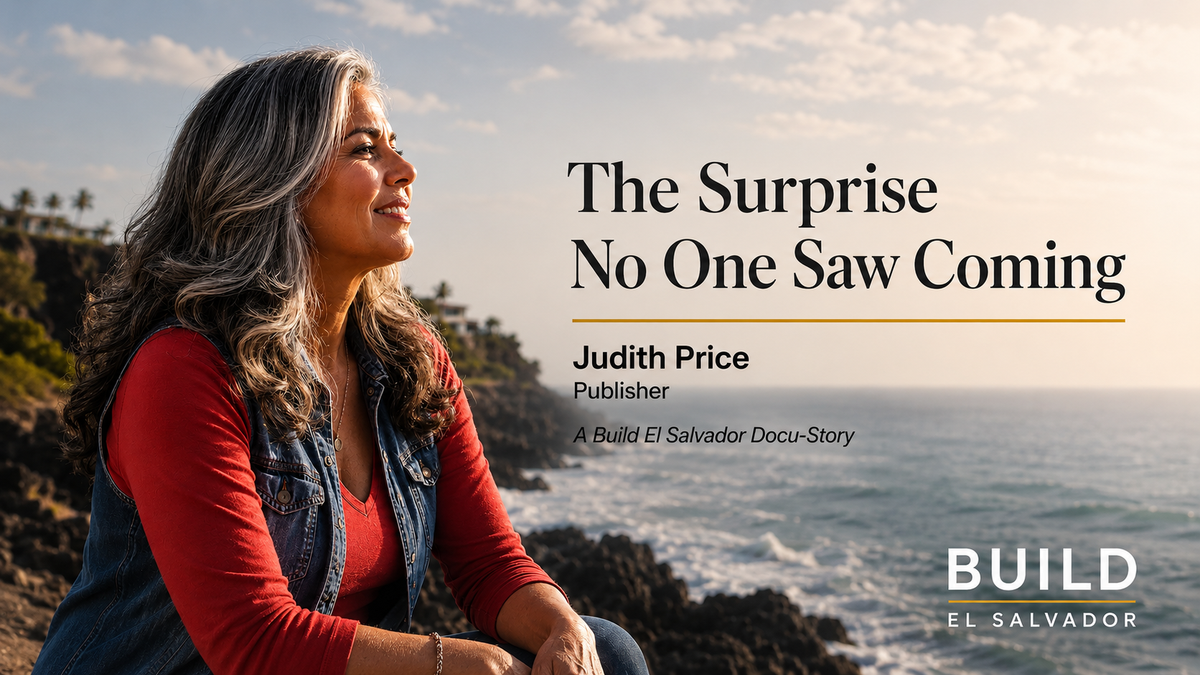
By Judith Price · Editor & Publisher
We landed at San Salvador just after eight in the evening, the last of the daylight already gone.
The airport was perfectly normal. Modern. Clean. Efficient. The kind of airport that gives absolutely no indication of what may come next.
Our driver was waiting, arranged through a reputable service. He spoke no English. We spoke no Spanish beyond the usual collection of travel words that sound far more useful in theory than they are in practice. We loaded our bags and headed toward the coast.
Then the lights disappeared. Not dimmed. Disappeared.
The road ahead was black. Not the familiar darkness of a country road back home where you still have a rough idea where you are. This was different. Dogs would appear in the headlights, stare at us briefly, then vanish back into the darkness like they had been assigned a shift. Construction barriers materialized without warning. Entire stretches of road seemed to emerge only when we were already on them.
The car wasn't helping. It was older, and the interior light didn't work. Not that it would have mattered much. We didn't have a local SIM card yet, which meant no internet, no Google Maps, no blue dot reassuring us that we were, in fact, somewhere. We couldn't see where we were going, couldn't see where we'd been, and had absolutely no idea how much farther we had to travel.
All we had was a driver we couldn't communicate with and a growing suspicion that we might be somewhere between civilization and a Stephen King novel.
My husband and I didn't say much. Partly because there wasn't much to say. Partly because we were both busy reviewing every alarming thing we'd ever heard about El Salvador.
What we didn't know at the time was that our driver had taken the old highway. What we also didn't know was that a brand-new four-lane highway existed, modern, well-lit, the kind of road that would have made this a completely ordinary airport transfer. Our driver simply didn't know about it. So instead we spent the next hour and a half bouncing through darkness, construction zones, and my rapidly expanding imagination.
Then, without warning, it appeared.
A giant red building. Bright enough to be visible from space. Around it, every familiar logo of North America. Starbucks, Pizza Hut, and Wendy's glowing against the darkness like a fast-food hallucination. I laughed. Not because it was funny. Because it was absurd. One minute I was mentally preparing for a scene from a crime documentary. The next I was staring at a Wendy's.
We made it to the hotel sometime after ten. High fence, barbed wire along the top, broken glass embedded in the wall. It was the kind of security that in another context would be alarming and in this context felt like the best thing I'd ever seen. A security guard waved us through. There was no receptionist waiting for us. No bustling lobby. Just a security guard who greeted us at the gate of the small boutique hotel and quietly led us through the property to our room.
When he opened the door, we both exhaled.
Garten Hotel was stunning. We admired it for nearly a full minute before the universe decided we were becoming a little too comfortable.
My husband had checked his pockets.
No phone.
Somewhere between the dark drive and our premature sense of relief, the phone had slipped out of his pocket.
It was after eleven at night. The hotel had no staff on duty, only the security guard. We had no local SIM card, no direct way to reach the driver, and no particular reason to believe we'd ever see the phone again.
Our only hope was the owner of the transportation company, whom we'd been communicating with on WhatsApp. After hunting down the guest Wi-Fi password, we sent a message into the digital universe and hoped for the best.
No problem, he said. I'll call the driver.
We waited.
Just after midnight, headlights appeared at the gate. The driver from BitDriver. With the phone. He had turned around and driven back through all of it. The construction, the dogs, the dark to return a phone to two strangers he would likely never see again. We paid him double what we'd already tipped him. It sure didn't feel like enough.
We had arrived in El Salvador knowing nothing about it except its reputation. And within hours of landing, a man we couldn't speak to had done something that a lot of people in a lot of places wouldn't have bothered to do.
That was our actual introduction to El Salvador. And that, I've learned, is El Salvador's first trick. It lets you think you've figured it out. Then it shows you something that doesn't fit the story you brought with you.
That's where the real story begins.
That shopping complex wasn't an anomaly. It was a clue.
El Salvador has been leaving clues for years. The problem wasn't that they were hidden. The problem was that almost nobody outside the country was looking for them. The reputation was simply too loud, too established, too convenient to question.
El Salvador was the smallest country in Central America. The most densely populated. The country that appeared on travel warnings. The country that spent decades making international headlines for all the wrong reasons. Eventually those headlines became the story. And once a story takes hold, it can survive long after reality has started moving on.
For decades, the reputation was earned the hard way. Civil war. Poverty. The rise of MS-13. Violence that became so familiar to outsiders that many people stopped thinking of El Salvador as a country and started thinking of it as a cautionary tale. The world looked, decided it understood, and looked away.
But countries don't freeze in time just because the rest of us stop paying attention. While the headlines kept repeating the same story, something else was happening. Roads were being built. Communities were changing. Businesses were opening. Surf towns were attracting visitors from around the world. Investment was arriving.
Most people never noticed. Until suddenly they did.
El Salvador emerged from a twelve-year civil war in 1992 with an estimated 75,000 dead and a country that looked exhausted. More than a million Salvadorans had fled during the conflict to the United States, to Canada, and anywhere they could build a safer life. The money they sent home became one of the country's economic lifelines, creating a remittance economy built, in part, by the people it had lost. Entire families survived because someone they loved had managed to build a life somewhere else.
Then came the gangs — and one of the most misunderstood parts of the El Salvador story is that MS-13 did not begin in El Salvador.
It began in Los Angeles in the 1980s, formed largely among Salvadoran immigrants and refugees who had fled the civil war. When gang members were later deported back to Central America, they arrived in a country still recovering from conflict, with weak institutions and little capacity to absorb what was coming.
The results were devastating.
By the 2010s, El Salvador had become one of the most violent countries on earth. In 2015, the homicide rate reached roughly 103 murders per 100,000 people. For comparison, Canada’s rate that same year was about 1.7.
Travel advisories followed. International media followed. The reputation followed. And eventually the reputation became bigger than the country itself. For many outsiders, El Salvador stopped being a place and became a warning label.
But there was always something missing from that story. Because while journalists were counting murders, people were still raising families. Children were still going to school. Businesses were still opening every morning. Churches were still full.
Life didn't stop. It adapted. And what impressed me most wasn't what Salvadorans survived. It was how normal they remained afterward. There is a resilience here that is difficult to explain until you experience it yourself. It’s a quiet confidence, a sense that difficult things can be endured because difficult things have already been endured. The world saw a broken country. What it missed was a population that had become extraordinarily tough. Not defeated. Not hopeless. Patient.
A people who had survived civil war, gang violence, economic hardship, earthquakes, hurricanes, and decades of being underestimated. Whether they realized it or not, their moment was coming.
Eventually, it came. When it came, it wasn't subtle either.
In 2019, a 37-year-old former mayor named Nayib Bukele was elected president, becoming the first leader in thirty years who didn't come from either of the two parties that had dominated Salvadoran politics since the civil war ended. He didn't look like a traditional president. He didn't sound like one. And he seemed perfectly comfortable with that.
While much of the political world still operated through press conferences and carefully scripted appearances, Bukele understood the internet. He understood attention. He understood narrative. Whether people admired him or criticized him, they paid attention to him. And for the first time in a long time, that meant people were paying attention to El Salvador.
Then came Bitcoin. In 2021, El Salvador became the first country in the world to adopt it as legal tender. The announcement landed somewhere between disbelief and ridicule. Many observers assumed it was a publicity stunt. Others thought it was reckless. Supporters called it visionary. But almost everyone agreed on one thing: it was impossible to ignore. For a country that had spent decades being defined by its past, the move sent a different message. El Salvador was no longer waiting for permission to be noticed.
Whether the Bitcoin experiment ultimately succeeds or fails is a question history will answer. So far, the evidence suggests it has done more than attract headlines. It helped position El Salvador as a country willing to innovate, take risks, and compete for global attention on its own terms. What's beyond debate is what happened next. The world started looking. Investors looked. Entrepreneurs looked. Developers looked. Digital nomads looked. Journalists who hadn't written about El Salvador in years suddenly rediscovered it on a map.
The country's Bitcoin policy has evolved since then, but the impact of that moment remains difficult to overstate. And while the headlines focused on Bitcoin, something much larger was happening on the ground.
Bukele's administration made public security its central priority.
The government's anti-gang strategy was aggressive, controversial, and impossible to ignore. Mass arrests followed. A state of exception expanded police and military powers. The construction of CECOT—the Terrorism Confinement Center, now one of the largest prisons in the world—became the physical symbol of a new approach.
Supporters saw decisive leadership.
Critics raised concerns about civil liberties and due process.
Both sides agreed on one thing: El Salvador was doing something dramatically different.
The homicide rate that had reached 103 murders per 100,000 people in 2015 began falling sharply. By 2023, it had dropped to fewer than 2 per 100,000. The scale of that transformation was so extraordinary that many international observers initially struggled to believe it.
Researchers checked the numbers. Journalists checked the numbers. Critics checked the numbers.
The numbers held.
Almost overnight, the country once known for violence became known for one of the most dramatic public-safety turnarounds in modern history.
The travel warnings didn't disappear immediately.
Reputations never do. But something else happened.
People started coming to El Salvador anyway. The effects are visible almost everywhere you look.
In 2019, El Salvador welcomed approximately 1.7 million international visitors.
By 2024, that number had reached 3.9 million. Nearly four million people visiting a country that much of the world still thought it was supposed to avoid.
Tourism revenue tells the same story.
Five years earlier, tourism accounted for roughly 6.4% of national GDP.
By 2024, it had reached 14%, generating an estimated $3.5 billion in foreign revenue.
That's not a travel trend. That's an economic shift.
In 2023, the United Nations ranked El Salvador among the fastest-growing tourism destinations on the planet. Foreign direct investment reached approximately $730 million that same year, more than triple the previous year's total.
Money follows opportunity. And increasingly, opportunity was pointing toward El Salvador. The growth isn't slowing.
More hotels are being built. More flights are arriving. More businesses are opening.
But perhaps the most telling sign is that more Salvadorans are returning home with money, experience, and skills earned abroad.
Construction cranes have become part of the skyline.
New roads are carving through mountains. Entire communities are changing in ways that would have been difficult to imagine only a few years ago.
These are not the numbers, or the signs, of a country standing still.
Statistics explain a transformation. People make you feel it.
The first thing most visitors notice, after the food and the Pacific coastline that frankly has no business being that beautiful, is the people.
And I don't mean that in the travel-brochure sense of "friendly locals."
I mean something more specific.
The woman at the fruit stand will negotiate with you over a few cents and somehow make the entire experience enjoyable. She haggles. She laughs. And when she talks you into that extra quarter, she practically celebrates and you can't help but celebrate with her.
The cashier at the grocery store is genuinely pleased to see you. The waiter isn't performing happiness because a tip depends on it. And if you become a regular somewhere, something interesting happens.
People start looking after you.
The man stocking produce quietly becomes your insider source for the best avocados. Someone points you toward the freshest fish. The lady at the bakery sets aside your favorite buns because she knows you'll be in later.
None of this appears on a receipt. Nobody is paid extra to do it. It's simply how many people here move through the world.
The more I learned about El Salvador's history, the more remarkable that became. History could have left bitterness behind, and it would have been entirely understandable if it had.
Instead, what I encountered was something else.
Gratitude.
Optimism.
Pride.
And perhaps most of all, an awareness that this moment matters. A sense that people understand how quickly things can change. That safety is not guaranteed. That opportunity is not guaranteed. And that when those things arrive, you don't take them for granted.
You show up for them.
That is not a small thing to be around.
If you're paying attention, it's quietly contagious. It's one of the reasons my husband and I made a decision that would have seemed completely unimaginable on the night we arrived at the airport.
We're retiring here.
El Salvador is not a finished story. That is precisely the point. The infrastructure is still being built—literally. New highways are still being carved through mountains. Beach communities that felt isolated only a few years ago are becoming connected. The airport is expanding and a new one is being built. New hotels are rising along stretches of coastline that, not long ago, were known mostly to surfers quietly sharing location pins with friends.
The investment keeps arriving. Tourists continue discovering the country. Entrepreneurs are taking chances. Builders keep building.
More expats are choosing to stay. Some for a month, some for a season, some, like my husband and I, arriving expecting one thing and leaving making plans that would have sounded completely ridiculous before we got here.
Then there are the digital nomads: reliable internet, Pacific time zone, warm weather, a lower cost of living, and a government actively trying to attract foreign investment and talent and who cherishes their citizens. That combination doesn't exist in many places anymore.
Of course, there are legitimate questions. Transformations this fast always create them. The same willingness to move quickly that drove security reforms is the same willingness that sometimes makes observers uncomfortable. Reasonable people disagree about parts of El Salvador's trajectory, and some of those questions deserve serious discussion. This isn't a fairy tale. It's a country. Real, complicated, imperfect, ambitious, and still very much in motion.
But there is one thing that feels increasingly difficult to argue with. Something real is happening here. The numbers suggest it. The investment suggests it. The construction cranes suggest it. The full restaurants suggest it. And the fruit-stand ladies suggest it too, usually while smiling as they talk you into spending slightly more than you intended.
We know about the new highway now.
Four lanes. Fully lit. Smooth pavement the entire way. The kind of road that makes the airport transfer feel like any other arrival in any other country. We've driven it many times since that first night. It takes about forty minutes. It is completely unremarkable.
But I'm glad we didn't take it the first time. The old highway gave us something the new one couldn't: the darkness, the dogs, the construction, the hour and a half of having absolutely no idea where we were.
That wasn't an anomaly. It was an introduction. Not to the dangerous country we'd been warned about. And not to the paradise that social media influencers were already busy selling. Something far more interesting than either. A country in transition, rewriting its own story.
The more time we spent here, the more clues we found. Eventually, the clues became impossible to ignore.
We're not ignoring them.
Judith Price writes across genres. She is the author of thriller novels, the creator of The FARMACY Project guide series, and the founder of Build El Salvador. Her work has been written while living in locations including Abu Dhabi and El Salvador, where she now documents the country's transformation through the people building it, investing in it, and choosing to call it home.