What Does El Salvador Sound Like?
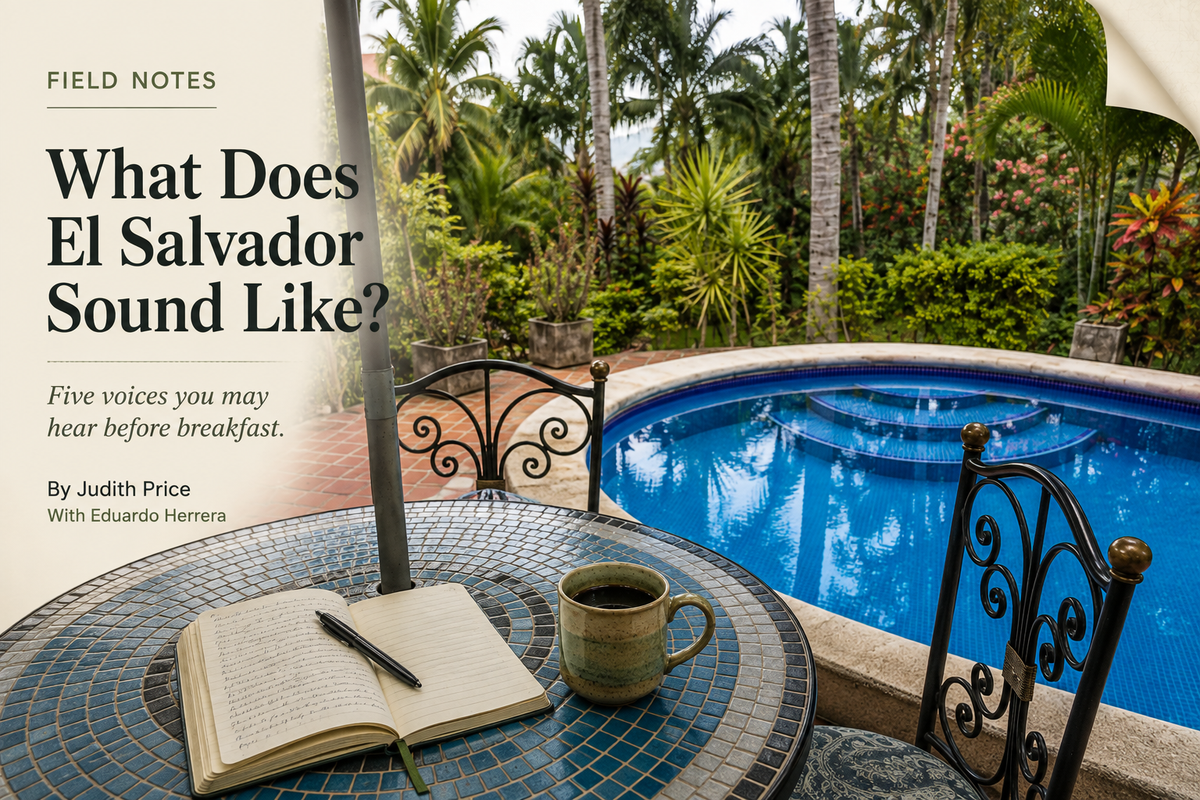
Five voices you may hear before breakfast.
Documented by Judith Price
With Eduardo Herrera, La Libertad
FIELD NOTES: Before we saw anything, we heard it.
We stayed at Eduardo's place for a few weeks, long enough that the mornings stopped being a novelty and started becoming a routine, which is its own kind of gift.
Every one of those mornings began the same way.
Not with an alarm.
With sound.
One call, then another, then something else layering over the top of it until the hillside was fully, unmistakably awake while we were still lying there with our eyes closed, coffee not yet made.
It was peaceful, but not because it was quiet. The hillside was alive with sound, calls overlapping, answering, rising and fading into the trees. Somehow, all that activity made the mornings feel even more still, as though we were waking up inside something that had been going on long before we opened our eyes.
You don't have to see much of El Salvador to know you've woken up somewhere different.
Sometimes you only have to listen.
Eventually curiosity got the better of me. I downloaded Merlin, an app that identifies birds by sound, and held my phone toward the trees.
One identification appeared. Then another. Then another.
They stacked up faster than I could read them.
By the time it settled, Merlin had identified eleven species from that one spot: Orange-chinned Parakeet. White-winged Dove. Cinnamon-bellied Saltator. Great Kiskadee. Golden-fronted Woodpecker. Ferruginous Pygmy-Owl. Great-tailed Grackle. Streak-backed Oriole. Baltimore Oriole. Melodious Blackbird. Common Squirrel-Cuckoo.
Eleven.
From a place that, on paper, was simply an Airbnb.
I couldn't help wondering how many places we'd stayed over the years without ever knowing who had been singing outside the window.
There were more than enough birds to fill an article. That's not really the story. Four of the voices came from that first recording.
The fifth came from Eduardo.
THE GENTLE ONE
White-winged Dove
Low, rolling, patient — the kind of sound that seems to come from everywhere and nowhere at once. Five notes, maybe six, repeating on a loop just slow enough that you stop expecting the next one, and it comes anyway.
Easy to overlook the first morning.
Impossible to overlook the tenth.
THE UNMISTAKABLE ONE
Great Kiskadee
There is no mistaking a Great Kiskadee once you know its name, mostly because the bird seems perfectly content shouting it at anyone within earshot.
Loud. Bright. Confident.
And just a little theatrical — the kind of call that cuts straight through everything else going on in the trees, whether you were listening or not.
Somewhere in the middle of all this listening, I started thinking about Eduardo.
He owns the property where all of this was recorded.
He didn't set out to build a bird sanctuary. He planted trees, created a place where people could slow down, and somewhere along the way the birds decided it suited them too.
I wanted to know what these mornings sounded like to someone who heard them every day.
Eduardo's answer could almost serve as the definition of FIELD NOTES itself.
“Day after day, you kind of stop paying attention to the little details. But when you stop and look around and listen, you start to see a lot of the beauty that surrounds you.”
That's exactly what we'd done.
Stopped.
Listened.
And suddenly an ordinary morning wasn't particularly ordinary at all. Eduardo doesn't know the name of every bird that visits his yard. That's almost beside the point.
There are pigeons, toucans and parakeets. Others he knows by their different sounds even if he couldn't tell you what they're called. And underneath all of it is another voice.
The Pacific.
“You hear the waves of the ocean in the background accompanying all the birds singing. It's just an amazing experience.”
The longer we talked, though, one bird kept coming up. That one Eduardo knew. We'll come back to it.
HERE COMES THE CHAOS
Parakeet
Nothing subtle about this one.
Parakeets don't perform solos. They move as a loud, restless group — a rolling, chattering static that builds from somewhere down the hillside and passes directly overhead before fading out the other side.
You generally hear the flock coming before you spot a single flash of green moving through the trees.
WAIT... THAT'S AN OWL?
Ferruginous Pygmy-Owl
This is the one that stops you.
Not because it's particularly loud.
Because once you realize what you're hearing, there's a moment of disbelief.
An owl.
Calling steadily, well into daylight hours.
THE CONVERSATION
Chachalaca
This one wasn't among the eleven birds my phone identified that morning.
Eduardo added it.
Of all the sounds around his property, the chachalacas were the ones he described almost immediately.
Not because they're particularly subtle. Because they seem to answer each other. One calls from one side of the property. Then another responds from somewhere else. Then another.
To Eduardo, it sounds less like birds calling and more like a conversation moving through the trees.
“We have chachalacas in the background. You can hear them singing. It's almost like they're talking to each other because you hear them from one end, and then you hear another one in another area.”
And suddenly the fifth voice wasn't one I'd found with an app. It was one Eduardo had already been listening to.
That's the part that stayed with me. You don't necessarily have to know what's making every sound. Sometimes you just have to notice that it's there. Maybe that's what makes Eduardo's place feel the way it does.
The birds aren't an attraction. The Pacific isn't background music. Nobody arranged the morning for the people staying there.
It's simply what happens when the hillside wakes up.
El Salvador is usually introduced through the things that photograph well.
Surf. Volcanoes. Black sand beaches. Sunsets. Pupusas.
All of those things are real.
But a country also holds smaller experiences that rarely make it into a tourism campaign.
Not because they aren't worth noticing. Simply because nobody thought to listen. That's exactly what happened here. The birds didn't need to be attracted. They simply needed someone to notice them.
There is one important caveat.
This isn't really what El Salvador sounds like. It's what this corner of El Salvador sounds like. These trees. This hillside. This stretch of Pacific coastline.
Wake up somewhere higher in the mountains, in the middle of San Salvador, or farther east, and the morning chorus changes entirely. That's less a limitation than an invitation.
Wherever you wake up here, it's worth listening.
I can still hear those mornings. No app. No species list. No need to know every name.
Just sound.
A dove somewhere nearby. A kiskadee calling from the trees. Parakeets tearing across the hillside. A chachalaca calling from one end of the property... and another answering from somewhere else.
And beneath all of it, steady and almost easy to overlook because it's always there, the Pacific rolling into shore.
For a moment, it feels like the whole hillside is listening. Then it simply continues, unbothered, unhurried, alive. This is what mornings sound like at Eduardo's.
And breakfast still hasn't started yet.
Where this Field Note was recorded
Eduardo Herrera's Airbnb
La Libertad, El Salvador
Stay here → https://www.airbnb.com/rooms/40657025
About the Contributor
Eduardo Herrera is Salvadoran and owns and operates a hillside Airbnb in La Libertad. Surrounded by tropical vegetation and overlooking the Pacific, the property has become a gathering place for an extraordinary variety of birdlife and the inspiration for Build El Salvador's first FIELD NOTES feature.
FIELD NOTES
Field Notes is a Build El Salvador series documenting the smaller details of a country in motion. The sounds, places, people and moments that are easy to pass by, and worth stopping long enough to notice.